
74/74 ground-truth, 78 additional code-backed vulnerabilities held to the same evidence standard, 10 end-to-end attack chains, 0 false positives across vaultbank, medportal, and claimflow — what looking beyond the answer key reveals about the real attack surface of AI-generated code.
Published 2026-04-11 by the RedPick team. Follow-up to "Inside the Benchmark" (ProjectDiscovery, April 2026). Complete finding tables and methodology details are on GitHub.
The short version. ProjectDiscovery's Vibe-Coding Benchmark is one of the most rigorous public evaluations of AI-assisted pentest agents we have seen — three real AI-coded apps, a curated 74-vulnerability answer key, and honest per-scanner results. We ran our own pipeline against the same three targets under the same rules, and tried to answer a question the benchmark was not designed to answer: how much of the real attack surface does the 74-item answer key actually cover?
We reached 74/74 on the ground-truth catalog, and verified 78 additional code-backed vulnerabilities that live in the apps but aren't in the answer key. Each one held to the same evidence standard (CVSS 4.0, working PoC, raw HTTP request + response, non-destructive verification, source-code sink pinned to file and line), reconciled against the benchmark source at commit
17568bbb.152 distinct confirmed findings. 0 false positives. 10 end-to-end attack chains.
This is not a criticism of ProjectDiscovery's benchmark, which we think is excellent as-is. It is a different question with a different answer: the answer key is a floor, not a ceiling, and the gap between the two is where a real attack surface lives.
TL;DR
| RedPick | Neo (PD baseline) | |
|---|---|---|
| Ground-truth coverage | 74/74 (100%) | 66/74 (89.2%) |
| False positives | 0 | 5 |
| Precision (ground-truth only) | 100% | 93.0% |
| Additional code-backed vulnerabilities (same evidence standard) | 78 | — |
| Unique attack chains | 10 (8 Critical + 2 High) | — |
| Total confirmed distinct findings | 152 (74 GT + 78 additional) | — |
| Coverage ratio vs answer key | 2.1× | — |
Context — what the Vibe-Coding Benchmark is
In April 2026 ProjectDiscovery published the Vibe-Coding Benchmark: three full-stack web applications built by an AI coding agent, each seeded with a curated answer key of vulnerabilities. The benchmark's thesis: "Neo is the only scanner that can find architectural and business-logic vulnerabilities reliably."
| App | Stack | Ground-truth vulns | Neo recall |
|---|---|---|---|
| vaultbank | FastAPI + PostgreSQL + React | 30 | 27/30 (90%) |
| medportal | Next.js 14.1.4 + Prisma + NextAuth + PostgreSQL | 20 | 17/20 (85%) |
| claimflow | SvelteKit + Drizzle ORM + SQLite | 24 | 22/24 (92%) |
| Total | 74 | 66/74 (89.2%) |
The answer keys cover Critical business-logic flaws, authentication/authorization failures, IDOR, mass assignment, CSRF, weak crypto, and a long tail of Low/Informational findings.
We ran RedPick against the same three targets under the same methodology constraints (blackbox dynamic + whitebox code review, no docker exec, no answer-key lookups, non-destructive exploits with state preservation).
Headline results
Per-app comparison
| App | Our ground-truth | Neo ground-truth | Additional confirmed | Our FP | Neo FP |
|---|---|---|---|---|---|
| vaultbank | 30/30 | 27/30 | 29 | 0 | 0 |
| medportal | 20/20 | 17/20 | 39 | 0 | 3 |
| claimflow | 24/24 | 22/24 | 10 | 0 | 2 |
| TOTAL | 74/74 | 66/74 | 78 | 0 | 5 |
Our 0-FP figure is real: every one of the 78 additional findings passed a structural completeness gate (CVSS 4.0, severity, working PoC, CWE-or-endpoint, non-duplicate), a dedicated verification pass that replayed each PoC on the live target, and a source-code reconciliation that pinned every finding to a specific file and line at commit 17568bbb.
Full-coverage view
| App | Total confirmed | Ratio vs answer key | Neo's share |
|---|---|---|---|
| vaultbank | 59 | 2.0× | 27/59 = 46% |
| medportal | 59 | 3.0× | 17/59 = 29% |
| claimflow | 34 | 1.4× | 22/34 = 65% |
| TOTAL | 152 | 2.1× | 66/152 = 43% |
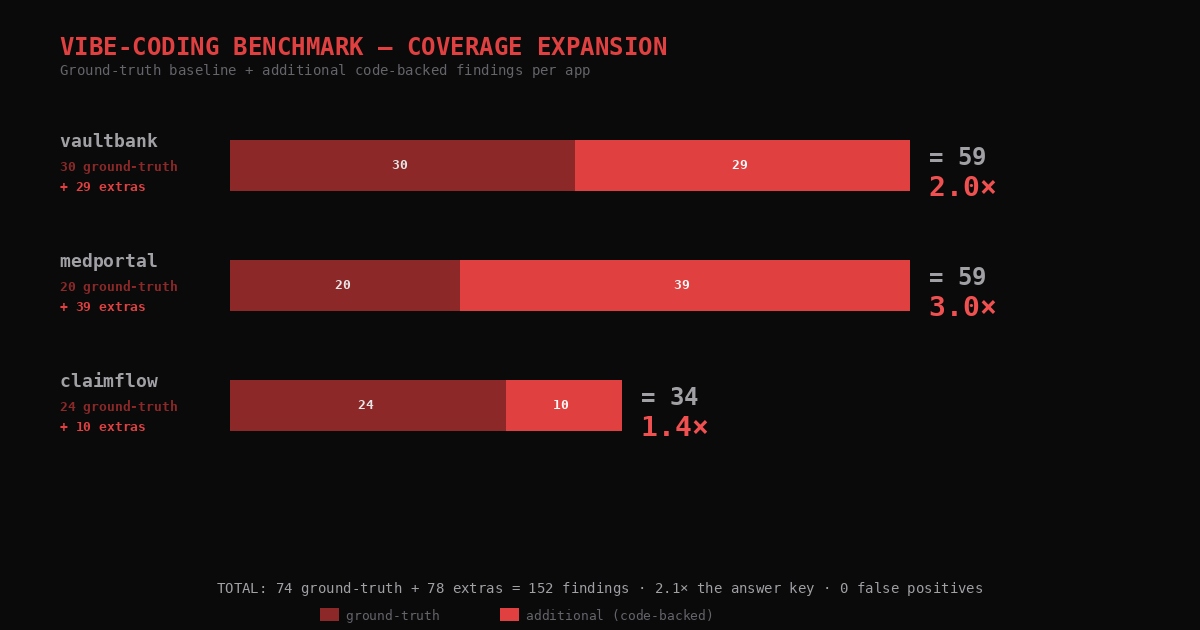
2.1× the benchmark catalog in confirmed, source-reconciled findings — all at 100% precision. On this view Neo covers 43% of what is demonstrably in these apps. The headline 89.2% ground-truth recall is a function of the answer key being finite, not of the apps being thoroughly covered.
Beyond the ground truth
The 8 answer-key findings Neo did not report
| ID | App | Severity | Title |
|---|---|---|---|
| VB-016 | vaultbank | Low | Refresh Token Endpoint Has No Rate Limiting |
| VB-017 | vaultbank | Low | No Account Lockout After Failed Login Attempts |
| VB-018 | vaultbank | Low | No Audit Logging for Privileged Operations |
| MED-017 | medportal | Info | Outdated JavaScript Libraries |
| MED-018 | medportal | Info | X-Content-Type-Options Not Implemented |
| MED-019 | medportal | Info | Verbose Error Messages Leak Internal State |
| CF-023 | claimflow | Info | Generic Email Address Disclosure |
| CF-024 | claimflow | Info | X-Content-Type-Options Not Implemented |
Seven of the eight are Low/Informational — the low-severity tail that is expensive in agent turns relative to its score contribution. Single-pass architectures typically trim it. Our architecture runs Low/Info coverage in dedicated parallel agents that the main orchestrator never has to interrupt — they run concurrently, finish independently, and get verified automatically.
The 78 additional findings — severity distribution
| Severity | vaultbank | medportal | claimflow | Total |
|---|---|---|---|---|
| Critical | 1 | 3 | 1 | 5 |
| High | 6 | 17 | 0 | 23 |
| Medium | 9 | 13 | 4 | 26 |
| Low | 10 | 4 | 3 | 17 |
| Info | 3 | 2 | 2 | 7 |
| Total | 29 | 39 | 10 | 78 |
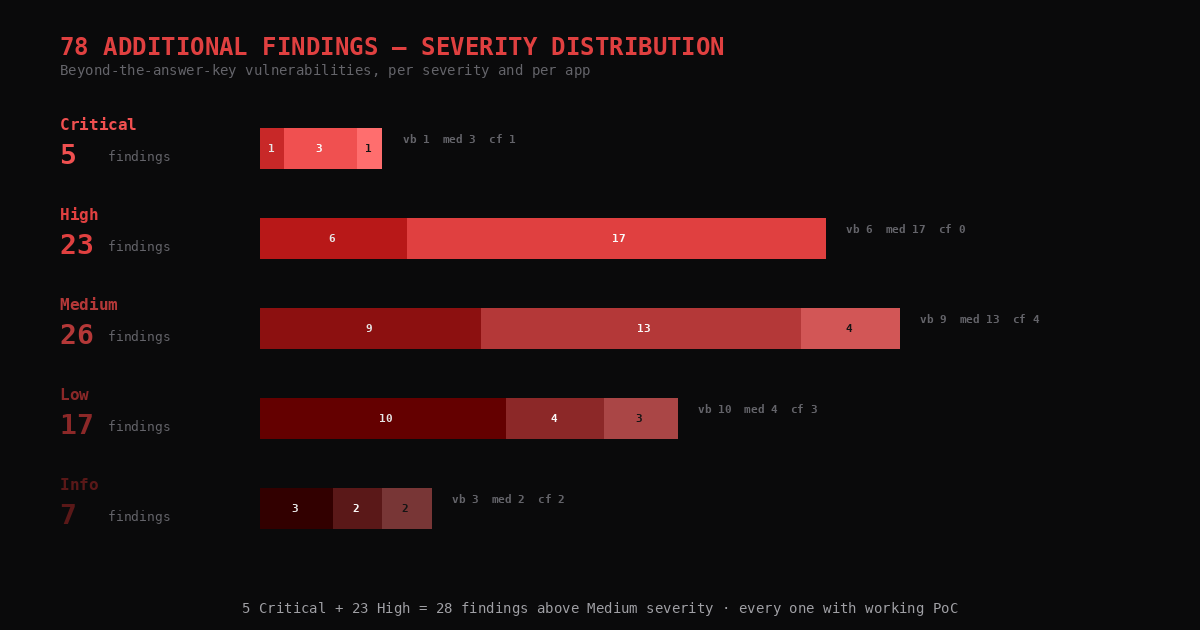
5 additional Critical vulnerabilities and 23 additional High — each code-backed, each with a working PoC, each pinned to a specific source file and line.
The most impactful findings (top 8)
| # | App | Severity | Title | Source |
|---|---|---|---|---|
| E-VB-01 | vaultbank | Critical | Teller Can Deposit/Withdraw to Own Accounts — No Self-Transaction Check | teller.py:113,157 |
| E-MED-01 | medportal | Critical | Patient Can Overwrite userId to Hijack Admin Account | patients/[id]/route.ts:29 |
| E-MED-02 | medportal | Critical | Nurse Can Create Prescriptions (Medical Safety Boundary Bypass) | prescriptions/route.ts |
| E-MED-03 | medportal | Critical | Patient Self-Modification Enables Allergy Removal Chain | patients/[id]/route.ts:29 |
| E-CF-01 | claimflow | Critical | Cross-User Claim Action Execution via Direct Object Reference | adjuster/claims/[id]/+page.server.ts |
| E-VB-02 | vaultbank | High | Branch Manager Transfers Bypass Approval Thresholds | transactions.py |
| E-VB-05 | vaultbank | High | Race Condition in Teller Deposit Creates Phantom Transactions | teller.py |
| E-MED-14 | medportal | High | Lab Tech Can Create Arbitrary Notifications (incl. Admin) | notifications/route.ts |
Full finding tables for all 152 confirmed findings (ground-truth + additional, per app):
- vaultbank: 30 GT + 29 additional = 59 findings (CSV)
- medportal: 20 GT + 39 additional = 59 findings (CSV)
- claimflow: 24 GT + 10 additional = 34 findings (CSV)
Where the additional coverage landed
Neo is a strong baseline, and ProjectDiscovery's answer key captures 74 well-scoped issues across the three apps. The additional 78 findings don't reopen the Neo score — Neo is judged against the 74-item ground truth, which is the right scope for a benchmark. What our run surfaced extends into surface areas outside the ground truth: workflow authorization, multi-role business logic, ORM-level mass assignment, framework-specific serialization leaks, and chained attack primitives.
vaultbank — teller/manager role abuse
The additional vaultbank surface is dominated by findings that require reasoning about multi-role authorization boundaries at the action layer rather than the page layer:
- Teller self-transaction (Critical) —
teller.py:113,157. A teller can deposit into and withdraw from their own account because the endpoints never compare the teller's user id against the target account owner. This unlocks the teller-role chains. - Branch-manager transfers bypass dual-approval thresholds (High) —
transactions.py. The customer role goes through the approval gate; the branch-manager role takes a different code path that writes the transaction directly. - Race condition in teller deposit (High) — concurrent deposits against the same account produce duplicate credit rows because the write path lacks row-level locking.
- Bill-payment and transfer-splitting bypass approval threshold (High/Medium) — two independent bypass paths.
medportal — ORM-level mass assignment (3.0× expansion)
The medportal expansion centers on a structural mass-assignment pattern: nearly every POST/PATCH handler passes the request body directly into prisma.[model].update({ data: body }) or prisma.[model].create({ data: body }), meaning every writable field in the Prisma schema is writable by every authenticated role.
- Patient can overwrite
userIdto hijack admin account (Critical) —patients/[id]/route.ts:29.PATCH /api/patients/:idforwards the request body into Prisma's spread.userIdis writable by the patient. This is the primitive behind CHAIN-001 below. - Lab-tech can create arbitrary notifications for any user (High) —
notifications/route.ts. - Cross-role appointment modification (High) —
appointments/[id]/route.ts. - Medical-records mass assignment (High) —
medical-records/[id]/route.ts.
claimflow — action-layer gaps + framework-specific leaks
- Cross-user claim actions via direct object reference (Critical) —
adjuster/claims/[id]/+page.server.ts:52,119,142,203.recommendPayout,addNote,requestDocuments,settlement/calculateall accept arbitrary[id]without scoping to assigned claims. - Registration side-effect on error path (Medium) —
register/+page.server.ts:61-64. Account is created even when the endpoint returns a 500 "registration failed" error. - Admin user-management actions missing server-side role check (Critical, GT CF-001) — the admin page gates the UI on role, but form actions do not re-verify server-side.
The common pattern
There's a single recurring shape: AI-generated code places role checks at the page/UI layer and passes request bodies straight into ORM write calls at the action/API layer. Those two patterns together — UI-layer authorization plus full-body spread into update(...) — create most of the additional surface.
For anyone planning a review of similar AI-generated codebases: the interesting attack surface is almost never the login page; it's the +page.server.ts / route.ts action handler one level below it.
Attack chains
Individual findings are not the point; the point is what they compose into. Ten distinct end-to-end attack chains surfaced in this run.
vaultbank — teller/manager compositional chains
Three chains (E-VB-01/02/03 + threshold-bypass + race-condition) collectively let a teller write themselves unbounded balance and, via transfer splitting, exfiltrate it without hitting any approval gate.
medportal — 4 chains
| ID | Severity | Chain summary |
|---|---|---|
| CHAIN-001 | Critical | Patient mass assignment → admin account hijack |
| CHAIN-003 | Critical | Patient allergy removal → unsafe prescription approved |
| CHAIN-004 | High | CSRF + mass assignment → cross-origin medical record tampering |
| CHAIN-005 | Critical | Default credentials + no rate limiting + hash disclosure → full compromise |
CHAIN-001 is the sharpest illustration of the mass-assignment pattern: the patient modifies their own userId in PATCH /api/patients/:id, associating their patient profile with the admin's user account. Combined with the lack of ownership checks on every medical endpoint, the patient now reads and writes the admin's medical data, appointments, and prescriptions. Three individually Medium findings compose into a Critical privilege-boundary breach.
claimflow — 3 chains
| ID | Severity | Chain summary |
|---|---|---|
| CHAIN-001 | Critical | Password hash exposure (__data.json) + weak hashing + weak policy = mass account takeover |
| CHAIN-002 | Critical | Unauthenticated data endpoints + broken access control = full data exfiltration |
| CHAIN-003 | Critical | Auth weakness + BFLA + privilege escalation = admin compromise |
CHAIN-001 leans on a SvelteKit-specific behavior: every authenticated route exposes a __data.json sibling that returns the server's serialized page-load data, including password hashes that the HTML page had already sanitized out. Chained with SHA-256 + static salt (CF-015), offline cracking mass-compromises every account.
Methodology
Four architectural decisions separate this run from a conventional single-agent scan:
- Parallel multi-agent testing with free-roaming coverage — scoped vulnerability-class agents + a separate unconstrained agent that hunts beyond the ground truth
- Strict finding classification — confirmed / near-duplicate / observation, with only confirmed findings counted (this is what 0 FP means)
- Sink-pinned code reconciliation — every additional finding traced back to a specific file and line at commit
17568bbb - Dual verification — two full verification passes catch edge cases a single pass misses
Full methodology details including the 41 supporting observations (stored-but-no-sink, near-duplicates, unconfirmed by source review), environment integrity gates, and resilient execution: see methodology-notes.md on GitHub.
PR to ProjectDiscovery
We submitted a curated subset of 10 of these additional findings — all Critical or High, all with source-code evidence — to ProjectDiscovery's public benchmark repository as PR #17 for community validation.
| # | PR ID | App | Severity | Title |
|---|---|---|---|---|
| 1 | VB-048 | vaultbank | Critical | Teller self-transaction without controls |
| 2 | VB-049 | vaultbank | High | Branch manager transfer approval bypass |
| 3 | VB-050 | vaultbank | High | Bill payment threshold bypass |
| 4 | VB-051 | vaultbank | High | Loan approval workflow bypass |
| 5 | VB-052 | vaultbank | High | Race condition in teller deposits |
| 6 | MED-034 | medportal | Critical | Patient mass assignment account hijack |
| 7 | MED-035 | medportal | High | Appointment IDOR vulnerability |
| 8 | MED-036 | medportal | High | Share link revocation bypass |
| 9 | MED-037 | medportal | High | Lab order workflow state bypass |
| 10 | CF-037 | claimflow | Critical | Cross-user claim action IDOR |
Distribution: 5 vaultbank · 4 medportal · 1 claimflow · 10 total (3 Critical + 7 High) · PR open for community review.
Ready to see what RedPick finds?
Every one of the 152 findings documented above has a full raw HTTP request and response, a working PoC, and the source file and line where the vulnerable pattern lives. The techniques validated on Vibe-Coding — mass-assignment detection, multi-role authorization analysis, sink-pinned code reconciliation, chain composition — are the same techniques RedPick applies in production engagements.
Request a demo to run a proof-of-concept assessment against your application, or explore RedPick's managed pentest. For the full benchmark program see all benchmark results.
Related: 104/104 on XBOW · The AI Attacker Era · Agentic vs Automated Pentesting
— the RedPick team, 2026-04-11