
Agentic vs Automated: Why Traditional DAST Falls Short
The application security industry has relied on Dynamic Application Security Testing (DAST) scanners for over a decade. These tools spray payloads at endpoints, check for known vulnerability patterns, and generate reports. They're automated, but they aren't intelligent.
This post breaks down what "agentic" actually means in a pentest context, which vulnerability classes DAST systematically misses, and where traditional DAST still has a role.
The automation trap
Traditional DAST scanners operate on a simple loop: crawl the application, inject predefined payloads, check responses against known signatures. This approach has three fundamental limitations.
Traditional DAST scanners often miss complex vulnerabilities that require multi-step reasoning or business logic understanding. The gap isn't in coverage — it's in reasoning.
1. No reasoning
A scanner doesn't understand your application. It doesn't know that the admin panel has different authorization rules than the user dashboard, or that the payment flow has business logic that could be exploited. It tests every endpoint with the same payload library.
2. No adaptation
When a scanner hits a WAF block or an unexpected response, it moves on. It doesn't reformulate its approach, try alternative attack vectors, or adjust its strategy based on what the application revealed.
3. No context
A low-severity IDOR on its own might be acceptable. Combine it with an SSRF and a privilege escalation path and you have a critical vulnerability chain. Scanners test in isolation. They can't chain.
What "agentic" actually means
An agentic system doesn't just execute — it decides.
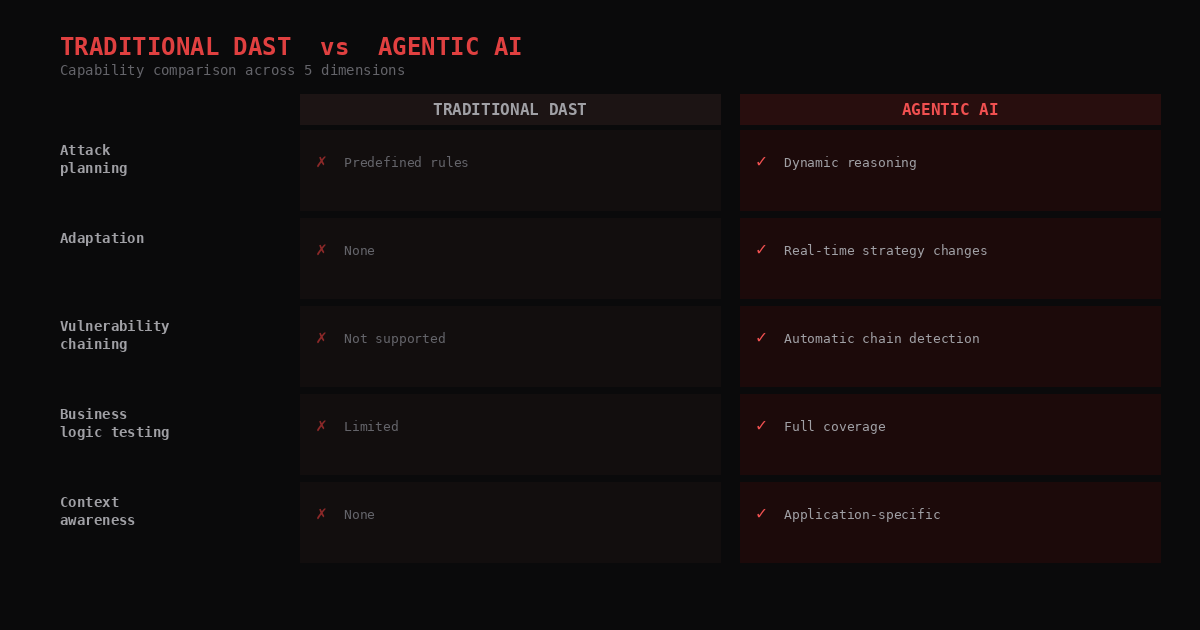
| Capability | Traditional DAST | Agentic AI (RedPick) |
|---|---|---|
| Attack planning | Predefined rules | Dynamic reasoning |
| Adaptation | None | Real-time strategy changes |
| Vulnerability chaining | Not supported | Automatic chain detection |
| Business logic testing | Limited | Full coverage |
| Context awareness | None | Application-specific |
For DAST baseline capabilities, see the OWASP Benchmark Project and ZAP's Benchmark scorecard.
RedPick's AI agent operates through a structured process:
# RedPick's agentic decision loop (simplified)

while target.has_unexplored_surface():
    context = analyze_current_state(target)
    strategy = plan_next_attack(context, findings)

    result = execute_strategy(strategy)

    if result.is_finding():
        chain = attempt_chain(result, previous_findings)
        if chain.severity > result.severity:
            report_chain(chain)

    adapt_strategy(result, context)
RedPick's agentic approach means it gets smarter as it tests — each finding informs the next attack strategy, just like a human pentester.
Three vulnerabilities DAST will never find
Abstract statements like "DAST misses business logic" don't land without examples. Here are three real vulnerability classes — each pulled from our benchmark runs — that no signature-based scanner can catch.
1. Chained IDOR + SSRF + privilege escalation
Individually, each of these is a Medium-severity finding:
- IDOR on a profile endpoint that accepts arbitrary
user_id - SSRF in an image proxy that fetches URLs for avatars
- A role field that's modifiable via mass assignment
Chain them together and you have a Critical: the attacker modifies another user's profile (IDOR) to set their avatar_url to an internal cloud metadata endpoint (SSRF), extracting IAM credentials that grant admin access to the entire account (priv esc).
DAST finds the IDOR. DAST finds the SSRF. DAST finds the mass assignment. DAST doesn't find the chain, because it doesn't reason about how those findings compose into impact.
2. Business-logic race conditions
Consider a payment flow: the server reads the account balance, subtracts the transaction amount, and writes the new balance. If the subtraction and the write aren't in a transaction, parallel requests can double-spend: send two purchases simultaneously, both read the same balance, both subtract successfully, and the user ends up owing the bank.
A DAST scanner sees an HTTP POST to /api/purchase returning 200 OK. That's the entire signal. To find the race condition, the tester has to:
- Understand that purchases consume balance
- Hypothesize that balance reads may not be atomic
- Construct a parallel-request test targeting that specific window
- Correlate the two responses to confirm double-spend
Every step requires reasoning about application semantics, not pattern matching against request/response bytes.
3. Encoding-boundary XSS
A payload like <script>alert(1)</script> is blocked by every modern WAF. But consider this chain:
- The application accepts
namein POST JSON, HTML-entity-encodes it on storage, and displays it in an HTML context - Admin panel displays the same
namein a JavaScript<script>block asvar greeting = "Hello {name}"; - The HTML entity encoding is not JavaScript-context-safe
Payload: "; alert(1); //. After HTML entity encoding, the characters are preserved (HTML entities don't affect quotes or semicolons). When rendered in the JavaScript context, the payload breaks out of the string and executes.
A DAST scanner tests each endpoint in isolation. It doesn't understand that input stored from endpoint A renders in a JavaScript context in endpoint B. It doesn't model encoding-boundary transitions. This vulnerability class is invisible to signature-based testing.
DAST vs agentic AI on public benchmarks
The gap isn't theoretical. Here is how the two approaches measure up on the three most rigorous public benchmarks for application security testing:
| Benchmark | DAST baseline | Agentic AI (RedPick) |
|---|---|---|
| XBOW CTF (104 challenges, 18 vuln categories) | Not tested (structurally incompatible — requires multi-step exploitation) | 104/104 |
| PortSwigger Academy (270 labs, 31 categories) | Not publicly reported | 270/270 + 5 mystery |
| ProjectDiscovery Vibe-Coding (74 GT vulns, 3 apps) | Checkmarx, Snyk, Wiz: see PD report | 74/74 + 78 additional |
On ProjectDiscovery's public baseline, traditional DAST tools (Checkmarx, Snyk, Wiz) score below 30% ground-truth recall on the same three apps. Neo (also AI-based) scored 89.2%. RedPick scored 100% and found 78 additional code-backed vulnerabilities outside the answer key.
The reason isn't that DAST is poorly implemented. It's that the vulnerabilities require reasoning, not pattern matching. For the full XBOW comparison across 11+ agents and humans, see our XBOW write-up. For the Vibe-Coding details, see our ProjectDiscovery write-up.
When does DAST still make sense?
DAST still has a real role in a security program, and pretending otherwise would be dishonest.
DAST is good at:
- Broad, shallow scanning at speed. If you need to check 500 internal apps for known-pattern misconfigurations (missing security headers, exposed debug pages, outdated dependencies), DAST does this cheaply and fast.
- Regression checks for known vulnerabilities. Once you've found and fixed a vulnerability, DAST can verify the fix on every deploy — signature matching is reliable when the target pattern is known.
- Compliance checkbox requirements. Some regulations explicitly require DAST scans. Agentic AI complements but doesn't always replace compliance-mandated DAST cycles.
- CI/CD gate for obvious issues. Catching SQL injection with a string literal payload before deploy is worth the 30-second scan time.
DAST is bad at:
- Business logic vulnerabilities (no signature matches)
- Multi-step attack chains (no cross-finding reasoning)
- Authorization flaws that span role boundaries
- Race conditions and concurrency bugs
- Encoding-boundary transitions
- Anything requiring reasoning about application state or user roles
The realistic stack
For most security programs, the right answer isn't "ditch DAST for agentic AI" — it's "use both at different layers":
- DAST on every deploy: 5-minute regression check for known vulnerabilities
- Agentic AI on every sprint or on-demand: deep testing with reasoning-level coverage
- Manual penetration testing annually: for scope-specific engagements requiring human judgment
Replacing DAST with agentic AI is like replacing unit tests with integration tests. Different layers, different purposes, both valuable.
Frequently asked questions
Can DAST find IDOR?
DAST can find the most basic IDOR instances — where incrementing a numeric parameter returns another user's data with no authorization check. But DAST misses:
- IDOR with UUID-based identifiers (signature matching requires numeric guessing)
- IDOR that requires understanding role boundaries ("a nurse shouldn't see a doctor's notes")
- IDOR across multiple endpoints that must be chained
- IDOR in GraphQL, gRPC, or other non-REST APIs
Is agentic AI a replacement for DAST?
Not for most organizations. Agentic AI is more expensive per scan (more compute, longer runtime). Using it as a CI/CD gate for every commit is overkill. The typical pattern: DAST for continuous regression, agentic AI for periodic deep-dives, manual pentesting for annual compliance or high-stakes scope.
Can agentic AI replace human pentesters?
For benchmark-style vulnerability discovery and exploitation, yes — our benchmarks show agentic AI matching or exceeding human pentesters on structured challenges. For consulting engagements requiring threat modeling, business context discussions with stakeholders, and judgment about which findings to prioritize in a specific organizational context, no — humans remain essential. The honest position: agentic AI raises the baseline floor so humans can focus on the work that actually requires human reasoning.
How does agentic AI handle false positives?
Our platform uses exploit-verification: every potential finding must be confirmed with a working proof-of-concept before it enters the report. No working exploit, no finding. This approach brought us to 0 false positives on ProjectDiscovery's Vibe-Coding benchmark — 152 confirmed findings, zero FP.
What about cost?
Agentic AI is more compute-intensive than DAST per run, but the cost comparison isn't scan-vs-scan. It's against the combined cost of DAST + manual triage of DAST false positives + manual exploit construction + manual report writing. When you factor in the 10-30% false positive rate of traditional DAST and the human hours spent triaging, agentic AI often comes out ahead per finding delivered.
Key takeaway
The question isn't whether your scanner found vulnerabilities. It's how many it missed — and whether you have any way of knowing.
DAST tells you about known-pattern vulnerabilities. Agentic AI tells you what an attacker reasoning about your application would find. Both have a place. The mistake is believing DAST alone is sufficient when the threat model includes attackers who reason.
Want to see the difference on your application? Request a free proof-of-concept scan and compare RedPick's findings against your existing DAST tool. No sales pressure — just the comparison.
Related reading: The AI Attacker Era · LLM Security Testing Guide · 104/104 on XBOW